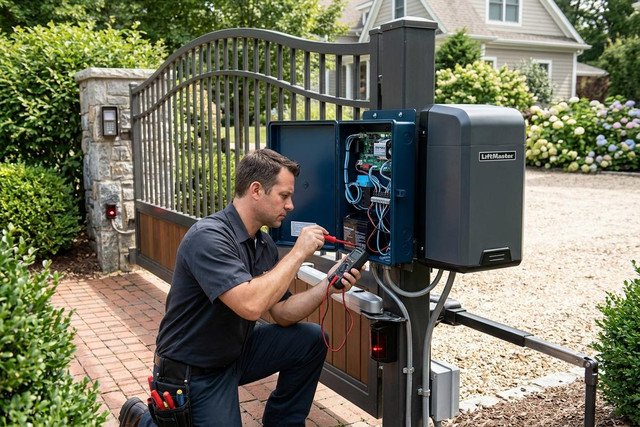
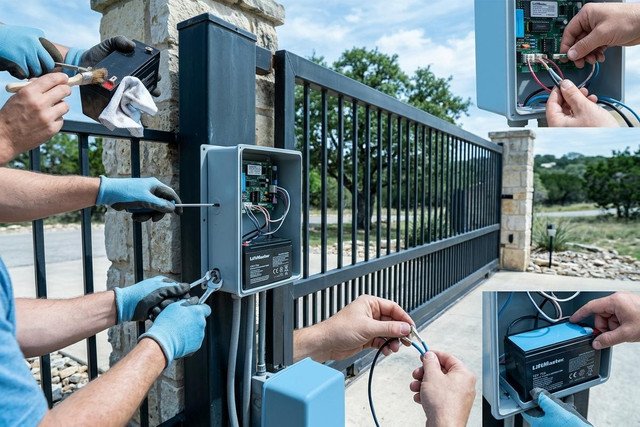
You can restore reliable gate access in under 30 minutes by swapping a failing LiftMaster gate opener battery before severe weather strikes. If your gate slows down or beeps, schedule prompt gate opener repair in Austin, TX, to avoid getting trapped. Our technicians test your power cells quickly. We also calibrate charging circuits so your driveway stays secure through hot summers and sudden power blackouts.
Driveway gates should never fail during bad weather or sudden power grid blackouts. Central Texas storms often cut main utility power without warning. Because of this, your system needs fresh backup cells to open and close smoothly. Testing terminal voltage twice each year stops sudden gate failures. Planning your equipment checks for 2027 keeps your home secure, safe, and easily accessible all year.
How Long Does a LiftMaster Gate Battery Last?
A standard LiftMaster gate battery lasts two to three years under normal conditions. However, extreme outdoor heat and high daily cycle counts degrade internal chemicals much faster. When units exceed three years of age, you should test their standing voltage regularly to prevent sudden failures.
The Central Texas climate plays a major role in shortening overall component life. For example, Austin summers routinely bring temperatures above 100 degrees Fahrenheit. This blistering heat bakes the metal control cabinet and dries out the electrolyte fluid. As a result, internal lead plates corrode prematurely. Most local property owners must replace their backup cells every two years to maintain reliable operation.
Signs Your LiftMaster Gate Opener Battery Is Failing
Spotting early warning signs protects you from getting locked out of your property. If the operator lacks adequate voltage, the motor struggles immediately to move heavy gate wings. You will often notice sluggish movement or jerky starts. Watch out for these common warning signs during your weekly driveway routines:
- The gate travels much slower than normal during opening and closing cycles.
- The control board emits three consecutive beeps after a complete cycle.
- The gate stops midway along the track and reverses direction without an obstruction.
- The entire system shuts down immediately during a neighborhood power outage.
- The arm works fine during hot afternoons but fails on chilly mornings.
Auditory alerts provide one of the most reliable diagnostic clues on modern operators. LiftMaster DC units draw peak motor current directly from the battery buffer. When voltage drops under load, the board sounds three distinct beeps to signal low power. If you ignore this alarm, the system will eventually stop responding to your transmitters entirely.
Which Battery Does My LiftMaster Need?
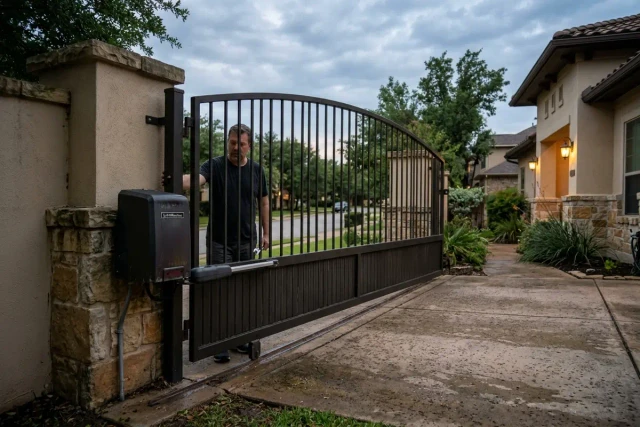
Choosing the correct replacement model prevents electrical faults and keeps your warranty intact. Most residential swing and slide gate operators use sealed lead-acid (SLA) batteries. Specifically, popular models like the LA400, LA500, and CSW24 run on two 12V 7Ah batteries. These two units connect in series to produce a 24-volt operating circuit.
Heavy residential setups, such as a large double gate opener, often demand higher energy reserves. Similarly, high-traffic commercial gates require dual 12V 33Ah batteries to handle frequent cycling. You should never mix old and new batteries together in the same cabinet. Replacing only one cell creates an electrical imbalance that ruins both units quickly.
You can verify your exact battery part number by reading the white label on your operator. Most standard 24V DC units use replacement kit part number K74-30762 or 29-NP712. High-capacity setups use part A12330SGLPK instead. If you compare a LiftMaster system to a FAAC gate opener, power demands and cabinet layouts differ significantly.
How to Replace a LiftMaster Gate Opener Battery in Austin, TX
Swapping your backup cells is straightforward when you observe proper electrical safety protocols. Automatic gate operators adhere to strict safety guidelines under the UL 325 standard. Always gather safety glasses, an insulated screwdriver, and your replacement batteries before opening the box. Follow these five clear steps to finish the replacement cleanly:
- Shut off main power: Turn off the dedicated circuit breaker and flip the power switch inside the control cabinet to the off position.
- Disconnect wire harnesses: Unplug the battery wire harness from the OmniControl board to isolate the electrical circuits completely.
- Remove old batteries: Disconnect the negative black lead first, then the red lead, and remove the series jumper wire between the two cells.
- Install fresh batteries: Seat the new 12V 7Ah cells securely, connect the red wire to positive, black to negative, and bridge the center terminals with the jumper wire.
- Restore power and test: Turn on main power, check that diagnostic LEDs show normal status, and run two complete cycles using your remote control.
Once you finish wiring the terminals, confirm that the control board diagnostic lights remain solid green. If the gate acts strangely or loses its travel limits, you may need a quick reset procedure. Resetting the board recalibrates the open and close positions so the gate stops precisely where it should.
Battery Not Charging? Check These Common Faults
A brand new battery will drain within days if your charging system is defective. When your control board fails to recharge the cells, the problem usually stems from an external component. Inspect the following parts before assuming your new power cell is defective:
- Incoming AC power: Check that the wall outlet provides 120V power and the transformer is not burned out.
- Internal fuses: Inspect the blade and glass fuses on the control board for broken filament wires.
- Solar panels: Clean off dirt, dust, and tree pollen from solar glass to restore maximum sunlight intake.
- Wiring harness: Look for corroded spade connectors or loose wires between the batteries and board.
Testing your system with a handheld digital multimeter delivers clear answers. Under active float charge, a healthy 24V system should measure between 25.5V and 27.6V across both batteries. If your reading stays below 24V while connected to main utility power, the charger board may have sustained electrical surge damage.
Battery Backup During Power Outages
A fresh battery backup allows your gate to cycle dozens of times during an outage. In typical residential installations, fully charged 7Ah batteries deliver between 20 and 50 cycles without utility power. However, adding accessories like safety loop detectors, optical photobeams, and wireless keypads increases passive power draw.
Cold winter storms also cut usable battery capacity by as much as thirty percent. During extended power outages, limit unnecessary gate opening cycles to conserve reserve voltage. Once utility power returns, the internal float charger requires 24 to 48 hours to restore both batteries back to full storage capacity.
Professional LiftMaster Gate Diagnostics and Repair in Austin, TX
Complex electrical issues require professional diagnostic tools and skilled hands. If your operator continues blowing fuses or refuses to hold voltage, the charging circuit has likely failed. Our certified technicians troubleshoot OmniControl boards, replace damaged wiring, and service high-use properties needing commercial gate repair.
Local experience makes a big difference when dealing with Central Texas weather extremes. We inspect control enclosures for pest intrusions, seal worn weather gaskets, and ensure uninterrupted access for 2027. Trusting our dedicated gate repair services saves you money by preventing accidental damage to expensive operator electronics.
Frequently Asked Questions
1. How long does a LiftMaster gate battery last?
A LiftMaster gate battery lasts two to three years on average. However, hot Austin summer temperatures above 100°F accelerate electrolyte dry-out. You should test terminal voltage every six months to prevent sudden lockouts.
2. How do I know which LiftMaster battery I need?
Check the model sticker inside your control box or your owner’s manual. Most residential DC models use two 12V 7Ah SLA batteries wired in series. High-cycle or solar units require larger 33Ah batteries.
3. Can a LiftMaster gate opener work without a battery?
No, LiftMaster DC gate operators cannot run without a battery installed. The DC motor draws heavy peak operational current directly from the battery buffer. Utility power alone cannot handle that immediate startup load.
4. Can I use a car battery for my gate opener?
No, you should never connect a standard automotive battery to your gate operator. Gate openers need deep-cycle sealed lead-acid batteries built for continuous float charging. Car batteries discharge incorrectly and create fire hazards.
5. Why does my new gate opener battery die fast?
A new battery dies quickly if the charging circuit on the control board fails. Blown board fuses, damaged wiring, or a dead AC transformer will also prevent the battery from recharging properly.
Call Austin Gate Repair today for fast, reliable Austin gate repair service in Austin, TX.
Call now for fast, reliable Austin gate repair service today.